
Executive Instructions Cannot Override Statutory Pay Rules: Punjab and Haryana High Court
Introduction
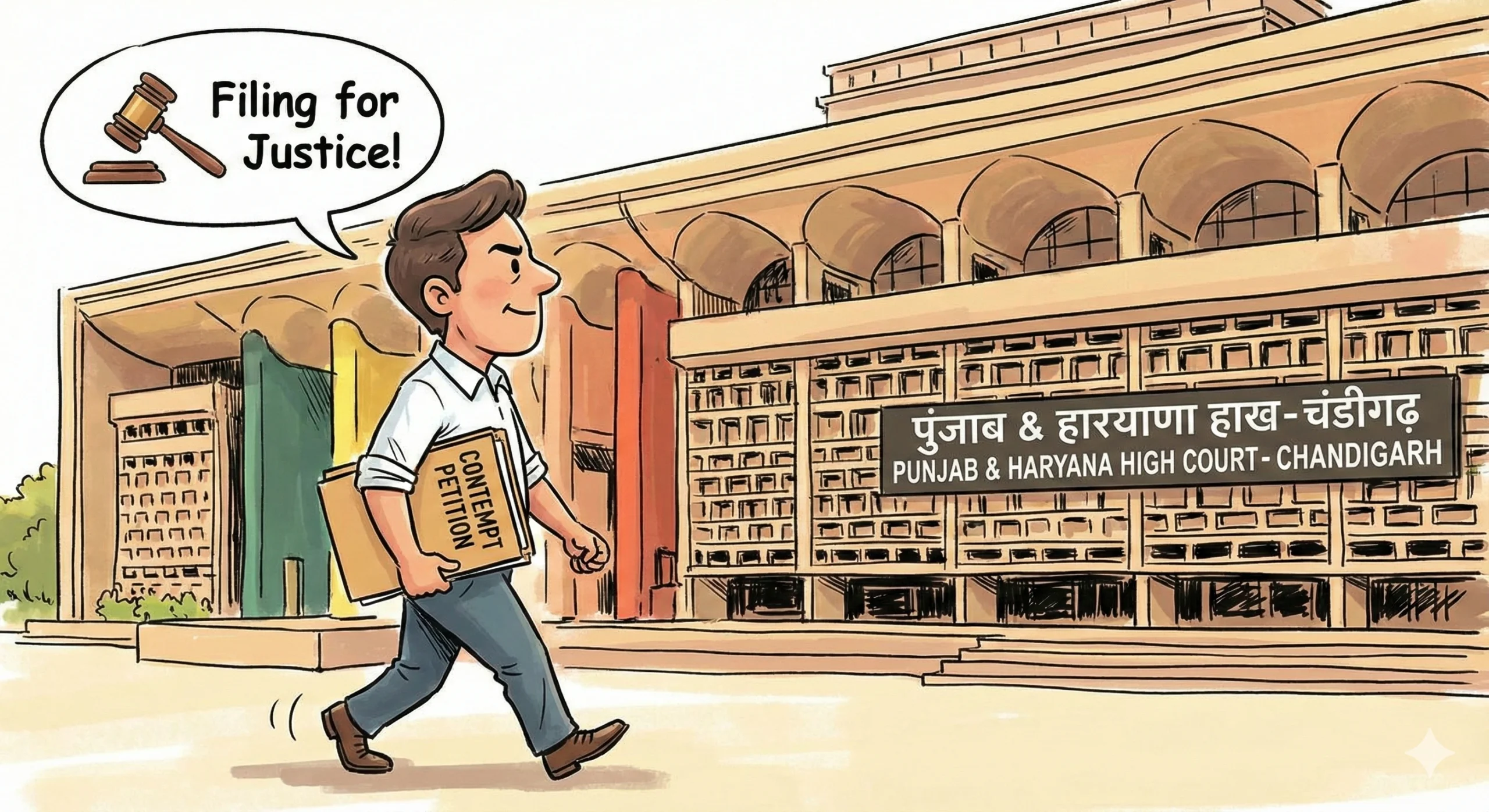
In a significant service-law ruling, the Punjab & Haryana High Court has reaffirmed a critical principle: statutory rules prevail over executive instructions, especially in matters relating to pay fixation and service benefits.
The case of Rajan v. State of Punjab & Others dealt with whether an employee appointed under the statutory Punjab Civil Services (Revised Pay) Rules, 2009 (revised in 2011) can be denied the rightful pay scale merely due to subsequent executive instructions prescribing a different pay structure under the 7th Central Pay Commission (CPC).
Justice Harpreet Singh Brar’s judgment reinforces legal clarity and ensures that government employees are not deprived of statutorily guaranteed pay scales.
Background of the Case
The petitioner, Rajan, was appointed as a Clerk with the Municipal Council, Gobindgarh, on priority/compassionate grounds.
Key facts:
- He was being paid ₹19,900 basic pay under the 7th CPC matrix, based on a Government letter dated 17.07.2020.
- However, no statutory notification existed to apply the 7th CPC to his post.
- The statutory pay rules of 2009 (revised 2011) prescribe pay under the 5th Punjab Pay Matrix, which is higher.
- His representation claiming the statutory pay scale was rejected on 19.09.2025.
- This rejection order was challenged in the writ petition.9
Petitioner’s Argument
The petitioner argued that:
- His appointment is governed by the 2009 Rules (as revised in 2011).
- The Government’s 2020 executive instructions cannot supersede statutory rules.
- He is entitled to higher pay scale and all consequential benefits.
- The impugned order denying him this right violates the principles of audi alteram partem and ignores the binding judgment in Saurabh Sharma v. State of Punjab, CWP-15896-2023.
Respondents’ Stand
The State contended that:
- As per instructions dated 17.07.2020, all new appointees must be paid as per 7th CPC entry pay.
- The petitioner accepted the appointment with the said pay scale.
- No specific notification exists for the post under 7th CPC, but the Government is following its latest instructions.
Court’s Analysis
Hon’ble High Court relied upon:
1. Single Bench judgment in Saurabh Sharma v. State of Punjab (CWP-15896-2023)
This judgment held that:
- Executive instructions cannot dilute statutory rules.
- Instructions dated 17.07.2020 are contrary to existing statutory rules and cannot be applied until the rules are amended.
2. Division Bench judgment in LPA-2977-2024 (State of Punjab v. Dr. Saurabh Sharma)
The Division Bench affirmed that:
- Employees appointed under statutory rules are entitled to pay scales prescribed therein.
- Lower pay cannot be imposed through mere instructions or appointment letters.
- Unless rules are amended, executive instructions have no authority.
Legal Principle Reaffirmed
The Court cited multiple Supreme Court precedents (Majji Jangamayya, Ashok Kumar Aggarwal, Krishna Rai, ESIC v. UOI, etc.) to reiterate that:
Statutory Rules > Executive Instructions
Executive directions:
- Do not carry the force of law,
- Cannot override or amend statutory rules,
- Are valid only when statutory rules are absent, or to fill gaps.
Final Order of the Court
The Court allowed the writ petition and directed:
✔ The petitioner shall receive the statutory pay scale under the
Punjab Civil Services (Revised Pay) Rules, 2009, revised 2011.
✔ All consequential benefits and arrears must be calculated and paid
within three months.
This ensures full restoration of the petitioner’s lawful entitlements.
Why This Judgment Matters
- Protects employees from arbitrary pay fixation.
- Reinforces supremacy of statutory rules over casual executive orders.
- Ensures uniform application of service rules across departments.
- Strengthens the rule of law in service jurisprudence.
This ruling is particularly relevant for employees appointed after 2020, municipal council employees, and those appointed on compassionate grounds.
Full Text of the High Court Order (CWP-32111-2025)
IN THE HIGH COURT OF PUNJAB AND HARYANA AT CHANDIGARH
109
CWP-32111-2025 (O&M)
Date of decision: 31.10.2025
Rajan …Petitioner
Versus
State of Punjab and others …Respondents
CORAM: HON’BLE MR. JUSTICE HARPREET SINGH BRAR
Present: Mr. S.P. Sohi, Advocate
for the petitioner.
Mr. Vikas Arora, DAG, Punjab.
Mr. D.S. Randhawa, Advocate
for respondent No.4.
HARPREET SINGH BRAR J. (Oral)
- Prayer in this writ petition filed under Articles 226/227 of the Constitution of India, is for issuance of a writ in the nature of certiorari, for quashing the order dated 19.09.2025 (Annexure P-11) passed by respondent No.4 as it violates principle of audi alteram partem and deliberately ignores the judgment of this Court in case titled as “Saurabh Sharma & Ors. vs. State of Punjab & Anr.” passed in CWP No. 15896 of 2023 (Annexure P-5). Further a writ of mandamus has been sought, directing the respondents to grant the pay scale and allowances to the petitioner as per Punjab Civil Services (Revised Pay) Rules, 2009 (Annexure P-4) revised in 2011 (Annexure P-12), along with all allowances applicable under the 5th Punjab Pay Scale Matrix, with further revisions, in view of the judgment in Saurabh Sharma’s case (supra), and for payment of arrears of salary along with interest.
- The brief facts of the case are that the petitioner, who was appointed as Clerk with Municipal Council, Gobindgarh on priority/ compassionate grounds, has been paid basic pay of Rs.19,900/- under 7th CPC pay matrix, based on a government letter/instructions dated 17.07.2020 (Annexure P-3). However, no notification fixing the pay scale under 7th CPC for this post has been issued. The petitioner claims entitlement towards pay and allowances as per Punjab Civil Services (Revised Pay) Rules, 2009 and its 2011 revision, prescribing pay on the basis of the 5th Punjab Pay Matrix. The petitioner filed a representation seeking the aforesaid relief, however, the same was rejected vide order dated 19.09.2025 (Annexure P-11). Hence, this writ petition.
- Learned counsel for the petitioner submits that the petitioner is entitled to pay and allowances as per the Punjab Civil Services (Revised Pay) Rules, 2009, as revised in 2011, which prescribe a higher pay scale for his post. It is submitted that the government’s letter/instructions dated 17.07.2020, applying the 7th Central Pay Commission pay scale, cannot override these statutory rules. Learned counsel relies on the judgment in Saurabh Sharma’s case (supra), wherein this Court has held that executive instructions cannot override the statutory rules.
- Per contra, learned counsel for the respondents submits that the petitioner’s pay scale is governed by the government’s letter/instructions dated 17.07.2020, which applies the 7th Central Pay Commission pay matrix to all new appointees, including the petitioner. It is further submitted that the petitioner’s appointment letter clearly refers to this letter, and thus the petitioner accepted the pay scale fixed therein. Learned counsel for the respondents further contends that there is no notification specifically fixing the pay scale of the petitioner’s post under the 7th CPC, but the respondents are paying the petitioner according to the latest government instructions. Hence, the claim based on the earlier 2009 Rules is not maintainable.
- I have heard the learned counsel for the parties and perused the record of the case with their able assistance. The issue involved in the present case is no longer res integra. A Coordinate Bench of this Court in Saurabh Sharma’s case (supra) has held that any executive instructions would not dilute or dislodge the implications of the applicable statutory rules. Speaking through Justice H.S. Sethi, the following observations were made:
“…11. In the present petitions, the pay scale of the post in question has been described in the 2016 Rules itself, hence, it cannot be said that by the Instructions dated 17.07.2020, respondents were supplementing the Rules. Rather the Instructions dated 17.07.2020 are contrary to the 2016 Rules qua the pay scale of the post on which petitioners are working and hence, said Instructions dated 17.07.2020 cannot be made operational till 2016 Rules are amended.
xx xx xx
14. Hence, once the 2016 Rules governing the service which have a statutory force, are operational and prescribes a particular pay scale for the post being held by the petitioners and have not been amended so far, the same has to be made applicable by ignoring the Instructions dated 17.07.2020, which are contrary to 2016 Rules, hence the respondents are directed to grant the petitioners the pay scale as envisaged under 2016 Rules i.e. 37,400 – ₹ 67,000/-+ ₹8600/- Grade Pay…”
6. The decision taken by the Single Bench of this Court in CWP No.15896 of 2023 was upheld by the Division Bench of this Court in LPA No.2977 of 2024 titled as ‘State of Punjab and another Vs. Dr. Saurabh Sharma and others’ wherein speaking through Justice Anupinder Singh Grewal, the following was opined:
“…6. It is manifest that the respondents having been appointed under 2016 Rules were entitled to the pay scales as prescribed thereunder. Merely because in the advertisement/appointment letters, the State had prescribed a lower pay scale, the same cannot come in the way of the respondents, seeking the enforcement of their lawful rights of getting the pay scales as prescribed under the statutory rules. It is trite that the executive instructions cannot override the statutory rules. In the event of the State intending to provide another or lower pay scales, the proper course to be adopted was the amendment of the rules. There is no dispute that the aforenoted rules have not been amended. Executive instructions would have the force of law only in the absence of statutory rules or to fill the gaps in the statutory rules which is not there in the case at hand.
8. Reference can be made to the judgments of Supreme Court in the cases of Union of India Vs. Majji Jangamayya, (1977) 1 SCC 606, Union of India Vs. Ashok Kumar Aggarwal, (2013) 16 SCC 147, Krishna Rai (dead) through LRs and others Vs. Banaras Hindu University through Registrar and others in Civil Appeal Nos.4578-4580 of 2022 decided on 16.06.2022 and Civil Appeal No.152 of 2022 titled The Employees’ State Insurance Corporation Vs. UOI and others, decided on 20.01.2022, whereby it has been held that in the event of conflict between statement in advertisement and service regulations, latter shall prevail…” (Emphasis supplied)
7. Indubitably, the instructions dated 17.07.2020 are executive in nature while the Punjab Civil Services (Revised Pay) Rules, 2009 (revised in 2011) under which the appointment of the petitioner was made, are statutory in nature. Executive or administrative instructions do not have the authority to amend, override or supplement statutory rules, nor can any such instructions be issued in derogation of the statutory framework. This is for the reason that administrative directions, being non-statutory in character, do not carry the force of law. On the contrary, statutory instructions, framed under the authority of an enabling statute, have the binding force of law, provided they are consistent with and not repugnant to the parent Act. Thus, while statutory rules occupy the field with full legal sanctity, mere executive instructions cannot operate to curtail, modify or expand their scope.
Reference in this regard can be made to State of U.P. v. Babu Ram Upadhyaya, AIR 1961 Supreme Court 751; B.N. Nagarajan v. State of Karnataka, AIR 1979 Supreme Court 1676; State of Tamil Nadu v. M/s. Hind Stone, AIR 1981 Supreme Court 711); P.D. Aggarwal v. State of U.P., (1987)3 SCC 622: (AIR 1987 Supreme Court 1676); State of Maharashtra v. Jagannath Achyut Karandikar, AIR 1989 Supreme Court 1133; State of Madhya Pradesh v. G.S. Dall & Flour Mills, AIR 1991 Supreme Court 772; C. Rangaswamaeah v. Karnataka Lokayukta, 1998(3) RCR (Criminal) 547: AIR 1998 Supreme Court 2496.
- In view of the above discussions, the present writ petition is allowed. The petitioner shall be granted the statutory pay scales as per the Punjab Civil Services (Revised Pay) Rules, 2009, as revised in 2011. All consequential benefits be calculated and the admissible dues be released to the petitioner within a period of three months from the date of receipt of a certified copy of this order.
- Pending miscellaneous application, if any, also stands disposed of.
(HARPREET SINGH BRAR)
JUDGE
31.10.2025
yakub
Whether speaking/reasoned: Yes/No
Whether reportable: Yes/No
Click here to download copy of order.

Related Posts


Comments (0)