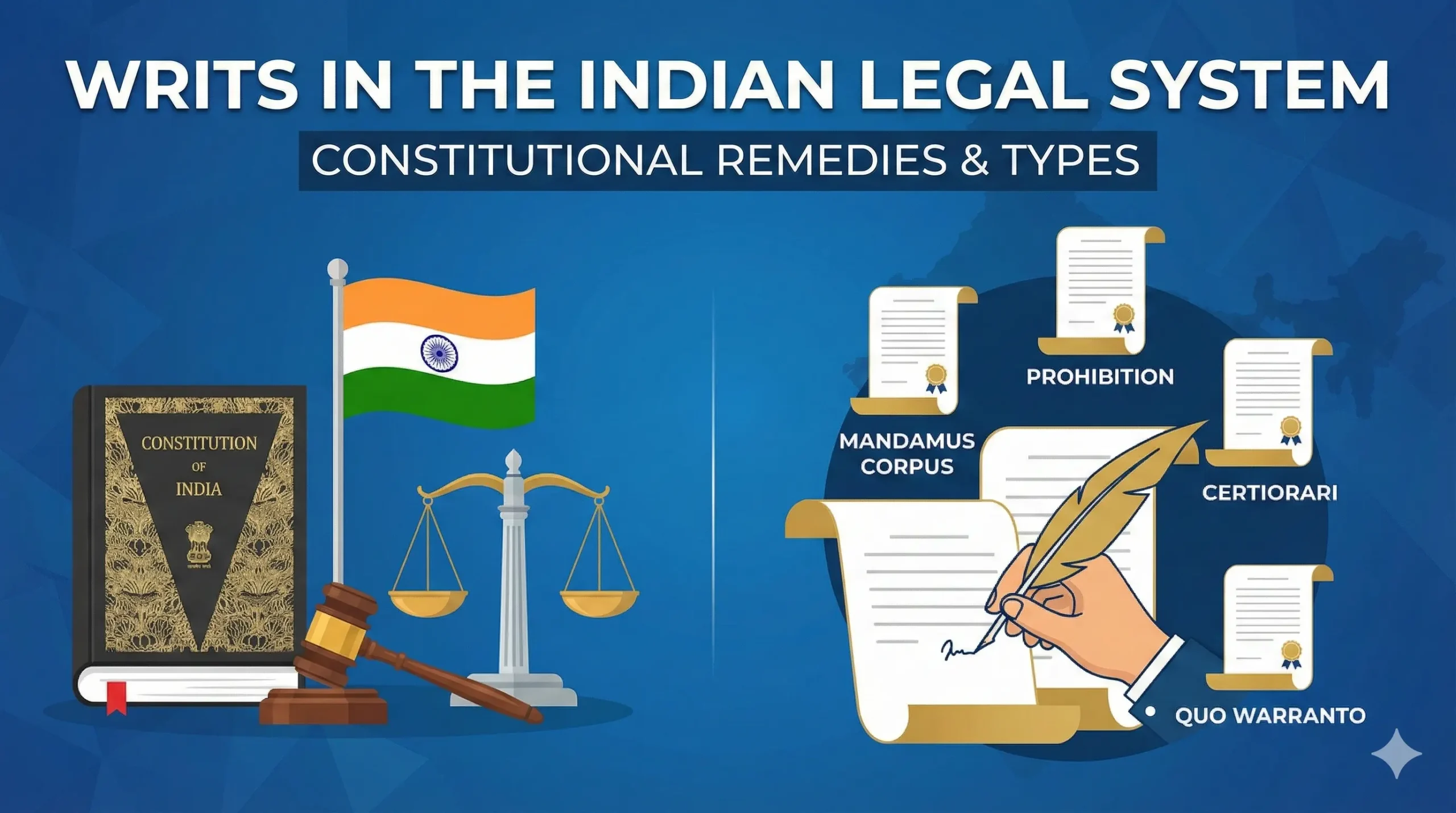
Constitutional Remedies: A Comprehensive Guide to Writs in India
In a democratic setup like India, the Constitution is supreme. It guarantees certain Fundamental Rights to its citizens. However, a right without a remedy is meaningless. If the State or any authority violates these rights, there must be a mechanism to enforce them. This mechanism is provided through “Writs.”
Dr. B.R. Ambedkar famously called Article 32, which provides the right to constitutional remedies via writs, the “very soul of the Constitution and the very heart of it.”
What is a Writ?
A writ is a formal, written order issued by a court holding constitutional authority, commanding an individual or an authority to perform a specific act or to cease performing a specific act.
In India, the power to issue writs is vested primarily in the Supreme Court and the High Courts. These are extraordinary remedies intended to ensure immediate justice when ordinary legal remedies are inadequate or unavailable.
The Constitutional Framework: Articles 32 and 226
The jurisdiction to issue writs is governed by two pivotal articles of the Indian Constitution. Understanding the difference between them is crucial.
1. Article 32: The Supreme Court
Article 32 is unique because the right to move the Supreme Court for the enforcement of Fundamental Rights is itself a Fundamental Right (under Part III of the Constitution).
-
Scope: The Supreme Court can issue writs only for the enforcement of Fundamental Rights guaranteed by the Constitution. It cannot issue writs for any other legal right.
-
Duty: Since it is a Fundamental Right to approach the SC, the apex court cannot refuse to entertain an application seeking protection against the violation of Fundamental Rights. The Supreme Court is the ultimate “guarantor and protector” of these rights.
2. Article 226: The High Courts
Article 226 empowers the High Courts of India to issue writs within their territorial jurisdiction.
-
Scope: The jurisdiction of the High Court is wider than that of the Supreme Court in this regard. A High Court can issue writs for the enforcement of Fundamental Rights and for any other purpose (i.e., enforcement of ordinary legal rights).
-
Discretion: The remedy under Article 226 is discretionary. The High Court may refuse to grant a writ if it feels there is an alternative, equally efficacious remedy available to the petitioner.
The Five Types of Writs
The Indian Constitution has adopted five specific types of writs from British Common Law. Each serves a distinct purpose in safeguarding rights.
1. Habeas Corpus
Literal Meaning: “To have the body.”
Purpose: This is perhaps the most powerful and frequently used writ for individual liberty. It is used to protect a person against illegal detention or unlawful arrest. When this writ is issued, the court orders the person detaining another to produce the body of the detainee before it. The court then examines the cause and legality of the detention. If the detention is found to be illegal, the person is set free immediately.
Key Features:
-
It is a check on the executive power to arrest.
-
Unique Aspect: Unlike other writs, Habeas Corpus can be issued against both public authorities and private individuals.
-
The principle of locus standi (who can file the petition) is relaxed here. A relative or friend can file the petition on behalf of the detained person.
When it does not lie:
-
If the detention is lawful (e.g., pursuant to a valid court order).
-
If the proceeding is for contempt of a legislature or a court.
2. Mandamus
Literal Meaning: “We Command.”
Purpose: Mandamus is a command issued by the court to a public official, public body, corporation, or lower court, asking them to perform a public duty that they have failed or refused to perform. It is used to enforce the performance of public duties by authorities.
Key Features:
-
It ensures that the administration remains accountable to the law.
-
The petitioner must have a legal right to demand the performance of that duty.
When it does not lie:
-
Against a private individual or private body.
-
To enforce a duty that is discretionary and not mandatory.
-
Against the President of India or State Governors.
-
Against the Chief Justice of a High Court acting in a judicial capacity.
3. Prohibition
Literal Meaning: “To forbid.”
Purpose: This writ is issued by a higher court (Supreme Court or High Court) to a lower court or a quasi-judicial tribunal to prevent it from exceeding its jurisdiction or usurping a jurisdiction that it does not possess.
Key Features:
-
It is a “stay order” against ongoing proceedings.
-
Timing is Key: It can only be issued while the proceedings are pending before the lower court and before a final order is passed. It is preventive in nature.
-
It is available only against judicial and quasi-judicial bodies, not against administrative authorities, legislative bodies, or private individuals.
4. Certiorari
Literal Meaning: “To be certified” or “To be informed.”
Purpose: Like Prohibition, Certiorari is also issued by a higher court to a lower court or tribunal. However, while Prohibition is preventive (stops proceedings), Certiorari is both preventive and curative. It is issued to transfer a case pending with a lower authority to the higher court OR to quash an order already passed by a lower authority.
It is usually issued on grounds of excess of jurisdiction, lack of jurisdiction, or an “error of law apparent on the face of the record.”
Key Difference between Prohibition and Certiorari: Prohibition is available during the pendency of proceedings to stop them. Certiorari can be issued even after the final order has been passed to quash that order.
5. Quo Warranto
Literal Meaning: “By what authority or warrant.”
Purpose: This writ is issued by the court to enquire into the legality of a claim of a person to a public office. It prevents illegal usurpation of a public office by an individual. The court asks the person, “By what authority are you holding this office?”
Key Features:
-
It can only be issued in case of a substantive public office of a permanent character created by a statute or the Constitution.
-
It cannot be issued against a private or ministerial office.
-
Unique Aspect regarding Locus Standi: Unlike most other writs where the petitioner must be an aggrieved party, any interested person can seek a writ of Quo Warranto, regardless of whether they are personally affected.
Conclusion
The writ jurisdiction provided by the Constitution ensures that the rule of law prevails over arbitrary actions of the State. These five writs act as powerful checks on administrative and judicial excesses, ensuring that the Fundamental Rights of citizens remain not just theoretical promises, but enforceable realities. They are the tools that keep the machinery of democracy functioning within its constitutional boundaries.

Related Posts



Comments (0)